


Dental adhesive for dentures: how to make the right choice?
Wearing removable dentures is a radical solution, but it allows you to enjoy life to the fullest because oral function is essential for eating, speaking, as well as for cosmetic reasons. Today's dentures are both comfortable and in harmony with your physique. They allow you to regain a completely normal use of the mouth.
Contenus
How are dentures attached?
If you have bad teeth and have to pull them out one by one, or if you have suffered an accident, removable dentures, partial or full, are an excellent solution. Indeed, you can use implants to secure a denture, but they are very expensive and when you are missing several teeth, removable dentures are often preferable.
On the other hand, if you suffer from a pathology such as periodontitis, your jawbones are too fragile to support implants. Removable dentures are the ideal solution, especially since you will no longer have to undergo recurrent care – generally unpleasant and painful – to repair teeth that are already very fragile.
Dentures can be partial or replace your entire dentition. It is fixed in the mouth by using the suction cup effect between your gums and the artificial part that covers them. In addition to the suction cup effect on the gums, when the denture concerns the upper jaw, it may have a part that overlaps on the palate and reinforces its anchorage. A denture on the lower jaw cannot be secured in this manner and will more often require the use of dental glue.
The dentist and prosthodontist will decide on the best solution for you, taking into account the teeth to be replaced and the configuration of your mouth.
Denture adjustment
At least once a year, you should have your dentures checked by your dentist to see if they need to be readjusted or changed. The mouth changes over time, especially if you have had several teeth removed.
The gums adapt to the absence of natural teeth and, with age, it is normal for the morphology of the jaw to change slowly.
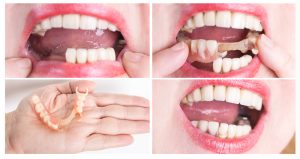
An ill-fitting denture loses its adhesion, even with dental adhesive. In addition, it can cause problems with chewing, and therefore with eating, occlusion and pronunciation.
How does denture adhesive work?
The dental glue for dentures is not strictly speaking a glue, because it is not intended to permanently weld your dentures to your gums!
A removable denture should be removed at night to give the gums and mouth 6 to 10 hours of relief. It also allows to clean and soak the dentures to eradicate all bacteria and possible stains.
The purpose of denture adhesive is to reinforce the natural suction effect created by the saliva that flows between the denture and the natural mucous membranes. Dental glue is more viscous than saliva, which is already relatively viscous. It therefore has a viscous consistency itself and must also stimulate the production of saliva to reinforce the bonding power of the denture.
The dental adhesive should be strong and reliable enough to hold all day and hold the denture firmly to prevent it from moving and coming loose. At the same time, it must be easy to remove in the evening.
Of course, the manufacture of the dental glue must obey a strict sanitary protocol to avoid any irritation, allergy or even intoxication. Finally, its flavor should be neutral or very weak, so as not to disturb your sense of taste.
The benefits of dental adhesive
In addition to the usefulness of the glue used to hold the dentures in place, its effect is also to protect the mucous membranes on which it is placed. It acts as a buffer between the prosthesis and the gum, which prevents bacteria and even food debris from getting lodged there.
It also eliminates any friction that might occur between the two parts in case of insufficient saliva, which could lead to irritation of the gums, even to lesions.
The dental glue keeps the denture moist, which is very important for the durability of the resin. Dentures are made of a material that degrades if it dries out. This is the reason why it stays soaked at night.
Finally, a good dental adhesive gives confidence to the person wearing the dentures. She is sure to be able to laugh, eat, talk, and even sing at the top of her lungs, without the risk of her dentures falling out.
Dental glue for dentures: instructions for use
Dental glue comes in the form of gel, cream, powder or adhesive strips. The most popular and easy to use packaging is the gel. It is easy to spread accurately and has a pleasant consistency. It's up to you to see what you like best by testing the different products.
1 – Before fixing your dentures for the day, make sure they are perfectly clean. There should be no food debris or glue residue left over from the previous day.
2 – The glue must be applied in the hollow of the false gums, in the center, by drawing a line with homogeneity. You must use little product, because it will spread by pressure, when you will fix the denture. If you use too much, the glue will spill out between the dentures and your gums.
Be reasonable about the amount on the first day and you will assess whether you need to add more the next day, assuming you have felt any adhesion problems during the day. In a few days, you will know how to precisely measure the quantity of glue.
3 – Place the device in your mouth and hold it for about ten seconds, the time it takes for the two parts to stick together. Avoid drinking or eating
FAQ
Which glue to use for a denture?
Many brands of dental glue exist on the market. Among them, Super Poligrip is often recommended by users.
How to maintain a denture without glue?
Among the products used to fix dentures, there is also Aggripdent flexible resin. This solution allows to maintain the denture for 12 months.
Where is the glue placed on the denture?
The glue is applied in the middle (in the hollow of the false gums) by forming a line or small points.